Memorize opening lines or train calculation?

Should you memorize opening lines or train calculation? For most club players, my answer is to learn enough of your openings to reach a normal middlegame, understand why each move is played, and spend most of your study time on chess calculation. The games back this up. When we counted 50,000 lost games, the opening decided 2 of every 100 losses, while a tactic decided 61.
That doesn't make openings useless. It just tells you where your hours pay off. Below is what's worth learning by heart, what you can leave to calculation, and how to split your time between the two.
Does anyone just memorize lines, or is it all calculation?
A thread on r/chess asked whether anyone really learns openings as bare lists of moves. The most upvoted reply simply said that everyone memorizes. The rest of the thread was more useful, and most of the replies agreed on a few points.
- Refutations are cheap. Learning how to punish one silly gambit you keep meeting takes very little effort, and it pays off at any level, because it keeps coming up in fast games. Learning hundreds of sharp main lines pays off far less.
- Knowing the idea isn't the same as knowing the line. Getting most of the moves right because you understand the plan is different from getting every move right, and at some level the exact moves start to matter.
- A gambit needs the line. If you give up a pawn, you need to know what happens when they take it, even if most of your opponents never do.
- Opponents leave the book early. Until you reach a high rating, ideas that carry over from one position to the next are worth more than deep lines you'll never reach.
- Memory and understanding mix. Several players said it's hard to learn moves without learning why they're played, and that some moves only make sense once you've played them in a few games.
The original post made one more point that I think is worth keeping. Plenty of players with a whole shelf of opening books still lose to cheap tricks, because they don't really look at their opponent's moves until well into the game. That part has nothing to do with opening knowledge. It's calculation.
What do 50,000 games say about openings and calculation?
For our study we took 50,000 decisive rapid and classical games from Lichess, 10,000 in each of five rating bands, and found the move that lost each one. The method and all the tables are in the 50,000-game study, but three of its numbers matter most for how you spend your study time.
Put those three together and the picture is quite clear. Early losses are real, especially under 1200, but they're rarely about a line you forgot. When a game goes wrong early, it has almost always left master theory already, and the mistake is a loose piece, a check nobody saw or a capture nobody counted. That's a calculation miss that just happens to come early in the game.
Why memorized lines run out before the calculation starts
A line you memorized only helps while your opponent keeps playing it, and at club level they rarely do for long. In our count, a mistake at move 2 or 3 was often made from a position still in master theory, but by move 8, 96 of 100 of these positions were not in master theory.
From that point on, neither player has a line to remember. You're on your own, and what you need is to see the next check, capture or threat in time. That's calculation, and no amount of opening study will do it for you.
An opening advantage also helps less than you'd expect. In these games, being half a pawn to a pawn better at move 15 scored 58%, while starting from a level position and making one blunder scored 35%. The opening edge moves your score a little. One missed tactic moves it a lot.
And a good opening doesn't protect you either. Of every 100 players who lost, 23 were ahead after the opening, and 68 of 100 of those went on to lose to a tactic.
What to memorize, and what to leave to calculation
You still need an opening, of course. The aim is to reach a middlegame you understand without walking into a known trap, and that takes less work than most players think. These are the things worth learning by heart.
- The first moves of each opening you play, as White, and as Black against the first moves you meet most, up to the point where the position settles.
- The reason for each move. If you know why the knight goes there, a different move order won't throw you.
- The punishment for the traps and gambits you meet most. A few short lines that you learn once and keep using.
- Your own gambits, to the end. If you give up material, know exactly how you win it back or what you get for it.
And these you can leave to calculation.
- Long main lines that end in a position that's only slightly better. You won't reach them often, and the edge is small anyway.
- Every sideline an opponent might try. When they leave your line, ask what their move attacks and what it stopped guarding, and calculate from there.
- Traps you hope they fall for. If a trick only works when your opponent helps you, you're learning to hope, not to play.
How to split your study time between openings and calculation
Nobody can give you an exact ratio, and I'm not going to make one up. What I can say is that the games point the same way at every level. Even at 2100 and up, the opening decided 2 of every 100 losses in our count, and a tactic decided 49.
- Under 1200. Spend almost all of your time on calculation and basic tactics. Half of all losses at this level were decided in the first 15 moves (30 plies), mostly by tactics, so the early game is where calculation counts most. For openings, learn the principles and the first few moves of one opening for each color.
- 1200 to 1799. Keep a small repertoire and learn the ideas behind it. Add a line only when one of your games shows you a gap.
- 1800 and up. Exact lines start to matter more, and several players in that thread said the same. The opening still decided very few games in our count, though, so keep calculation as the main work.
There's one habit that settles the question for you. After a loss, find the move where the game turned. If it came after you had already left your preparation, more opening study wouldn't have saved that game, and in our count 96 of 100 early mistakes came after the game had left master theory. In that case it was a calculation miss, and the fix is a quick check before every move. The three questions before every move are a good place to start.
Train calculation in the openings you play
In the end the two don't have to compete. A good way to learn an opening's ideas is to calculate the tactics that come up in it, because those are the positions you'll actually reach.
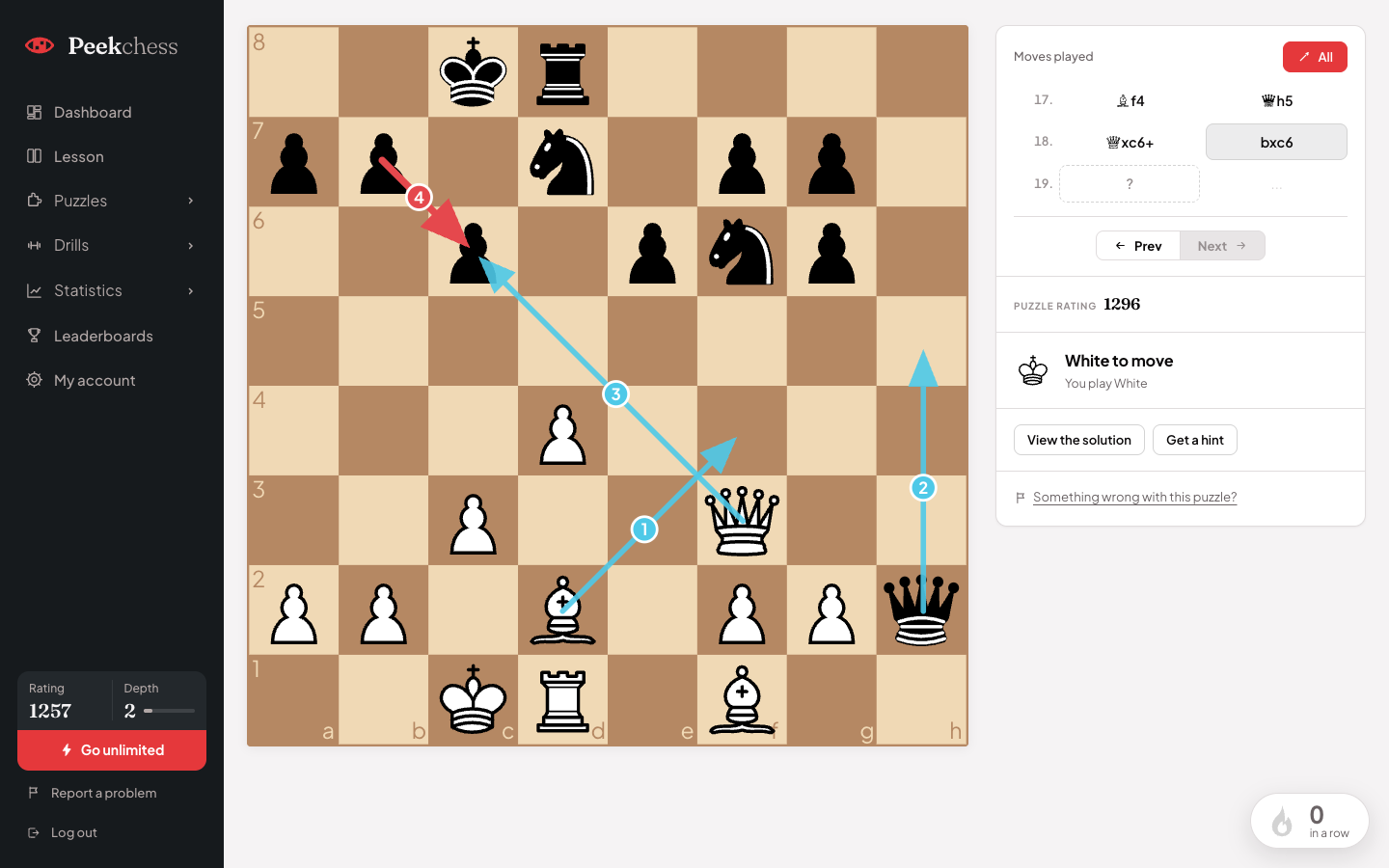
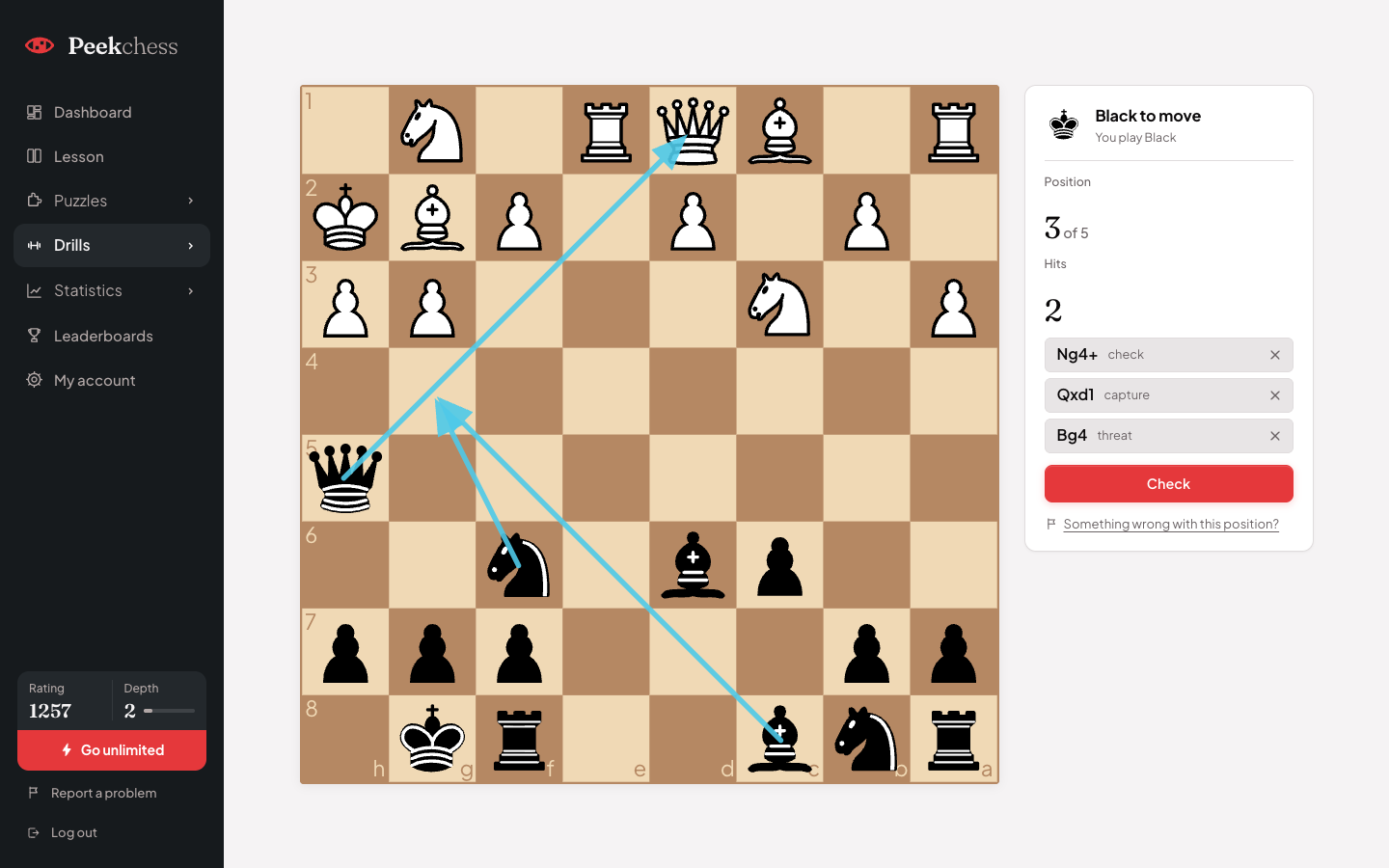
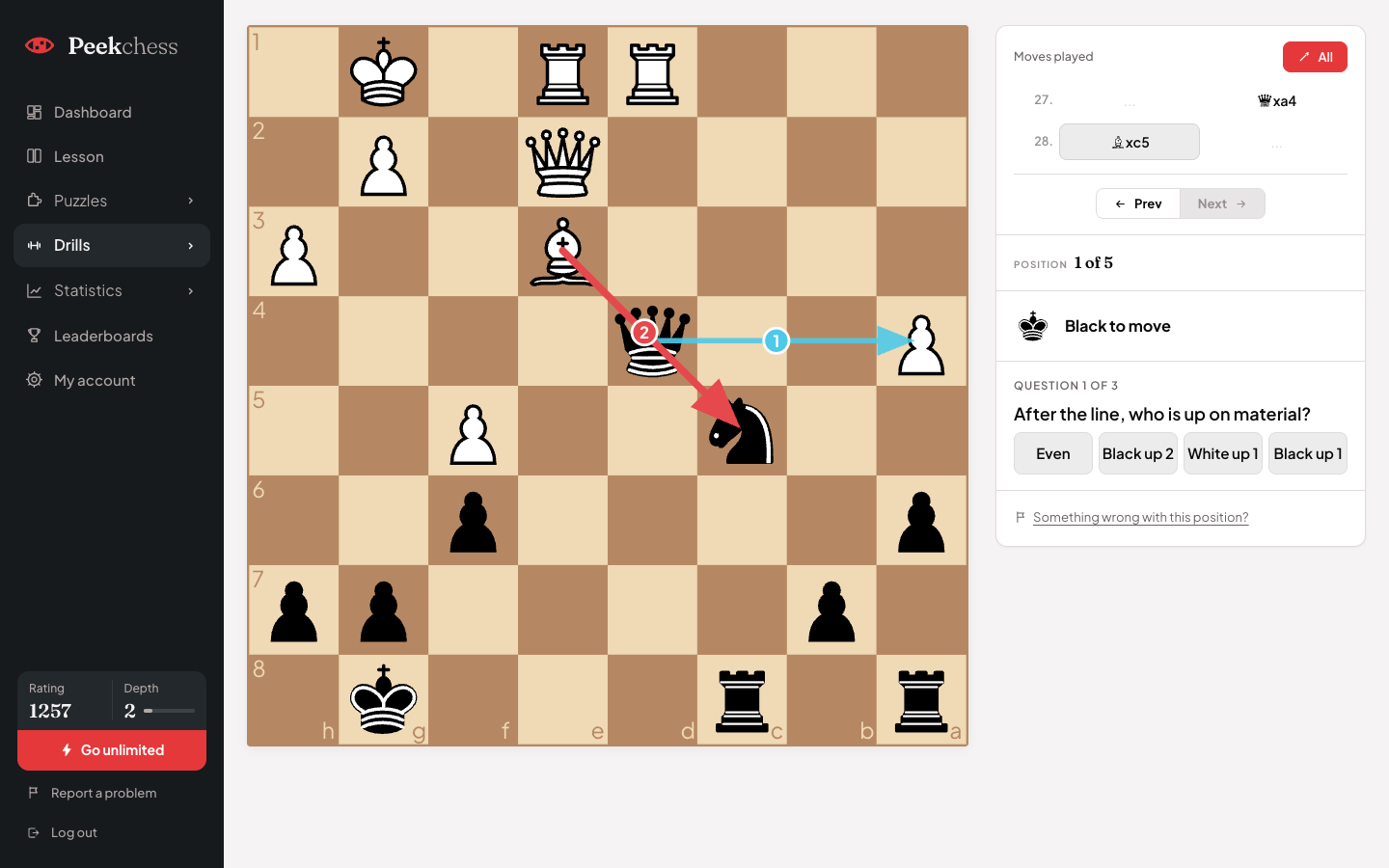
That's how a Peekchess lesson is put together. It's ten puzzles at your level, five from the openings you play and five aimed at what you keep missing. The pieces never move while you solve. Each move is checked as you play it, each move is drawn as an arrow, and one wrong move ends the puzzle, so you have to hold the new position in your head, just as you would in a game. You can read more about how a lesson works.
And if you want the steps of a calculation itself, from spotting the moment to judging where the line ends, they're in how to calculate in chess.
If you're still choosing where to solve puzzles, here are the best chess puzzle apps in 2026.
Read next. Do tactics matter more than openings? 50,000 games, Chess strategy and Can adults still improve their chess calculation?.
Should I memorize chess openings?
Learn the first moves of the openings you play and the reason behind each one, plus how to punish the traps you meet most. Beyond that, your time is better spent on calculation. In our count of 50,000 games, the opening decided 2 of every 100 losses and a tactic decided 61.
Is it bad to memorize opening lines without understanding them?
It works until your opponent plays something different, and at club level that happens early. If you know why each move is played, you can find your way once they leave the line. In practice most players end up learning the moves and the ideas together.
Do openings matter more at a higher rating?
The exact moves matter more as your opponents get stronger. Even so, in our count the opening decided 2 of every 100 losses at 2100 and up, the same as at most other levels, while a tactic decided 49.
What should I study instead of openings?
Chess calculation and tactics. Before every move, look at the checks, captures and threats for both sides, then calculate the forcing lines to the end. Solve puzzles where you work out each reply in your head instead of watching the pieces move.
How many opening moves should I memorize?
There's no fixed number. Learn each opening until the position settles and you know the plan, and learn how to punish the traps you meet most often. Past that point your opponents rarely stay in the book anyway.