Hard chess puzzles to test your calculation

A hard chess puzzle is rarely hard because of its first move. It's hard because of what comes after it. The line is long, there's a quiet move hidden in the middle, the defender has a real resource, or the ending only works if you count it to the last pawn. Here are ten of them from real games, rated from about 2100 to about 2600 and ordered from the easiest to the hardest. White plays in each one, and every solution is at least three moves long.
Ten hard chess puzzles to calculate, easiest first
These are difficult chess puzzles in the honest sense. You won't find the answer by spotting a pattern and playing it. Over each board is a rough difficulty, taken from the puzzle's rating. Take as long as you need, and only open the answer once you've calculated your own line to the end, so you have something to compare it with.
White to play. Find the winning move.
Show answer
1.Qxg7+ Kxg7 2.Nf5+ Kg8 3.Nh6#. The knight move is a double check with the bishop on b2.
White to play. Find the winning move.
Show answer
1.Kc2 g5 2.hxg5 h4 3.g6 h3 4.g7 h2 5.g8=Q h1=Q 6.Qg7#. Count the race, and push g6, because 3.gxh4 is stalemate.
White to play. Find the winning move.
Show answer
1.Rg1 Rd2 2.Rxd2 b1=Q 3.Rh2#. The quiet Rg1 covers g3 first, so Rh2 becomes mate.
White to play. Find the winning move.
Show answer
1.Qxf8+ Kxf8 2.Ne6+ Kg8 3.Rd8+ Kh7 4.Rxf7+ Kh6 5.Rh8#. Black threatens Qxa2 mate, so every move has to be a check.
White to play. Find the winning move.
Show answer
1.Rh1+ Kg7 2.Rxh8 Kxh8 3.c5 Kg7 4.Ke5 Kf7 5.Kd6 Kf6 6.Kc7 Ke5 7.Kxb7 Kd5 8.Kb6. The quiet 3.c5 fixes Black's pawns, and the white king reaches them first.
White to play. Find the winning move.
Show answer
1.Qg5 Rg8 2.Qxg8+ Kxg8 3.Rd8+ Qxd8 4.Rxd8#. Qg5 threatens Qg7 mate, and after the queen sacrifice the back rank is empty.
White to play. Find the winning move.
Show answer
1.Rxg7+ Kxg7 2.Rf7+ Kg8 3.Ne4 Bxe6 4.dxe6 Rh7 5.Nf6+ Kh8 6.Rxh7#. The quiet 3.Ne4 heads for f6, and Black can't stop the mate.
White to play. Find the winning move.
Show answer
1.Qxg6+ hxg6 2.Rh8+ Kf7 3.Ne5+ Ke8 4.Rxf8+ Kxf8 5.Nxd7+ Ke7 6.Nf6. Ne5+ forks king and queen, and White comes out a piece up.
White to play. Find the winning move.
Show answer
1.Nh5 gxh5 2.Ng5 Bxg5 3.Qxg5+ Kf8 4.Qxd8+. Two quiet knight moves, then Qxg5+ forks the king and the rook on d8.
White to play. Find the winning move.
Show answer
1.Qxh7+ Kxh7 2.Rfg3 Qf7 3.Rh4+ Qh5 4.Rxh5#. The hard move is the quiet 2.Rfg3, which keeps the king on the h-file.
What makes a chess puzzle hard to calculate?
In most of the ten above, the first move is a check or a capture you'd look at anyway. What makes them hard is everything after it, and that usually comes down to four things.
Long lines. Every move you add is one more position you have to see without it being on the board. Three moves in, it's easy to forget that a piece has gone, or that a square it used to guard is now open. Puzzle 7 is six moves long, and the position where it ends looks nothing like the one you started from.
Quiet moves. We're taught to look at checks and captures first, and that's right, but it also means a quiet move in the middle of a line is easy to miss. Puzzles 2, 3, 6 and 9 start with one, and in puzzles 5, 7 and 10 it comes later, after the checks have run out. If you stop calculating when there's no check left, you never find them.
Defensive resources. In an easy puzzle the defender has one reply. In a hard one they have a real try, like a stalemate, a pawn about to queen or a mate threat of their own. This is where most wrong solutions come from. The line is calculated well, but the opponent is given the move we'd like them to play, not their best one. In puzzle 2 Black is playing for stalemate, and in puzzle 4 Black is one move away from mating White.
Counting. Some lines end in a race or a trade, and the only way to know who comes out ahead is to count. Whose pawn queens first, how many moves the king needs, what's left once all the captures are over. Puzzles 2 and 5 are races, and puzzle 8 gives up the queen and only works if you count every piece that changes hands.
How do you calculate a hard chess puzzle?
The same way every time, in the same order, before you touch a piece.
- 1Find your candidate moves. Before you calculate anything, list every move worth a look, usually two to four of them. In a hard puzzle the right move often looks no better than the others, so give each one a fair look.
- 2Calculate the forcing moves first. Checks, then captures, then threats. They leave your opponent the fewest replies, so they're the quickest lines to calculate. If none of them works, go back and look for a quiet move.
- 3Give your opponent their best reply. At every step, put yourself in their place and look for their checks, captures and threats. If you only calculate the reply that makes your line work, you're hoping, not calculating.
- 4Blunder-check the final position. When the line ends, stop and look at the position you've reached as if it were on the board in front of you. Is anything hanging, is your king safe, and are you really ahead? Count the material.
The last step is the one most players skip. You calculate five moves, you feel sure, and you miss that the last capture comes with check, or that your queen is loose in the final position. A line isn't finished until you've looked at where it ends, and a lot of blunders come from a line that was right and stopped one move too early.
Why hard puzzles are good calculation practice
Easy puzzles train pattern recognition, and you need that too. You see the answer in a second, though, and there's nothing left to calculate. A hard puzzle makes you work through a line, check it, find the hole in it and start again, and that is the skill you use in a game when the position gets complicated and the clock is running.
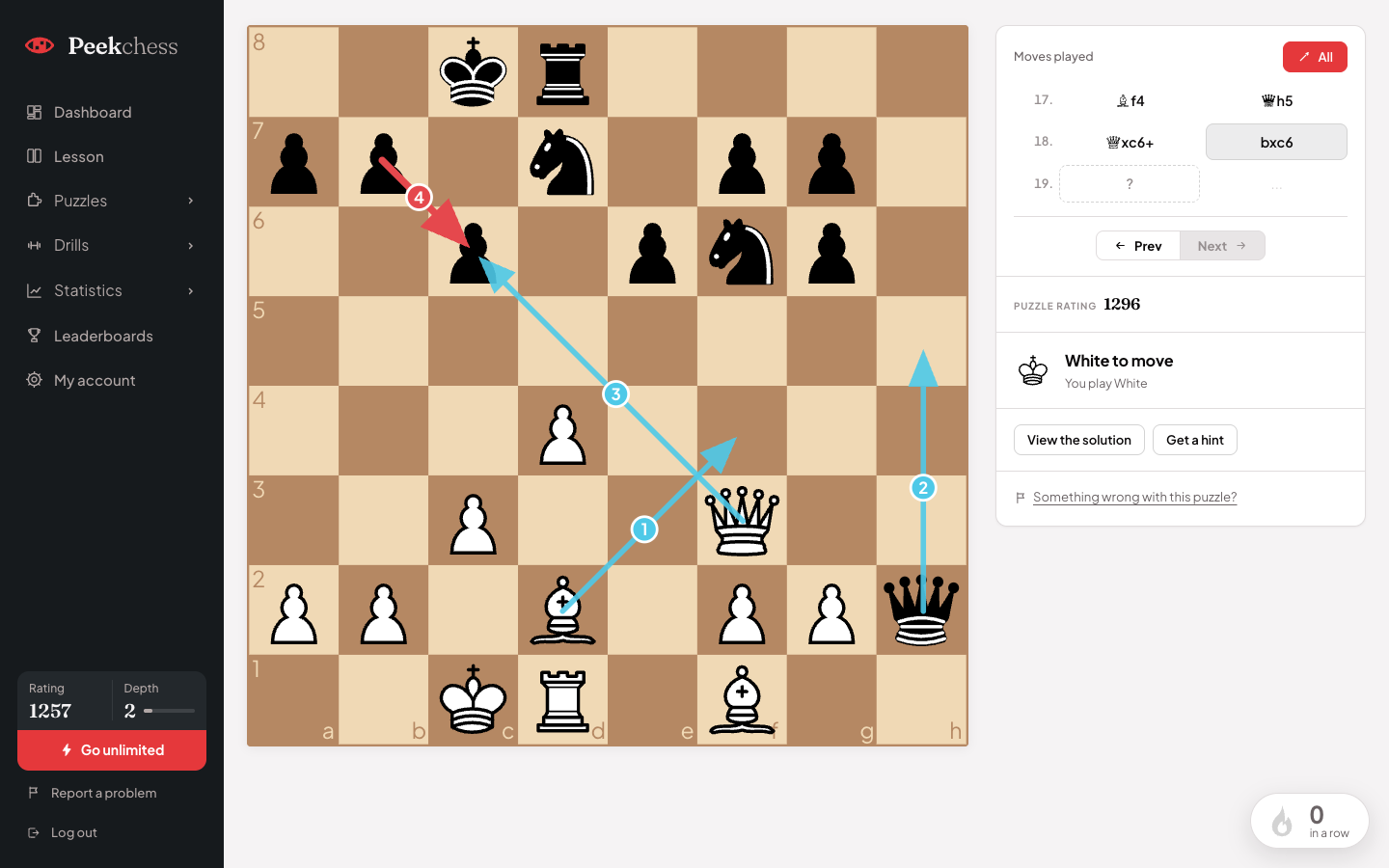
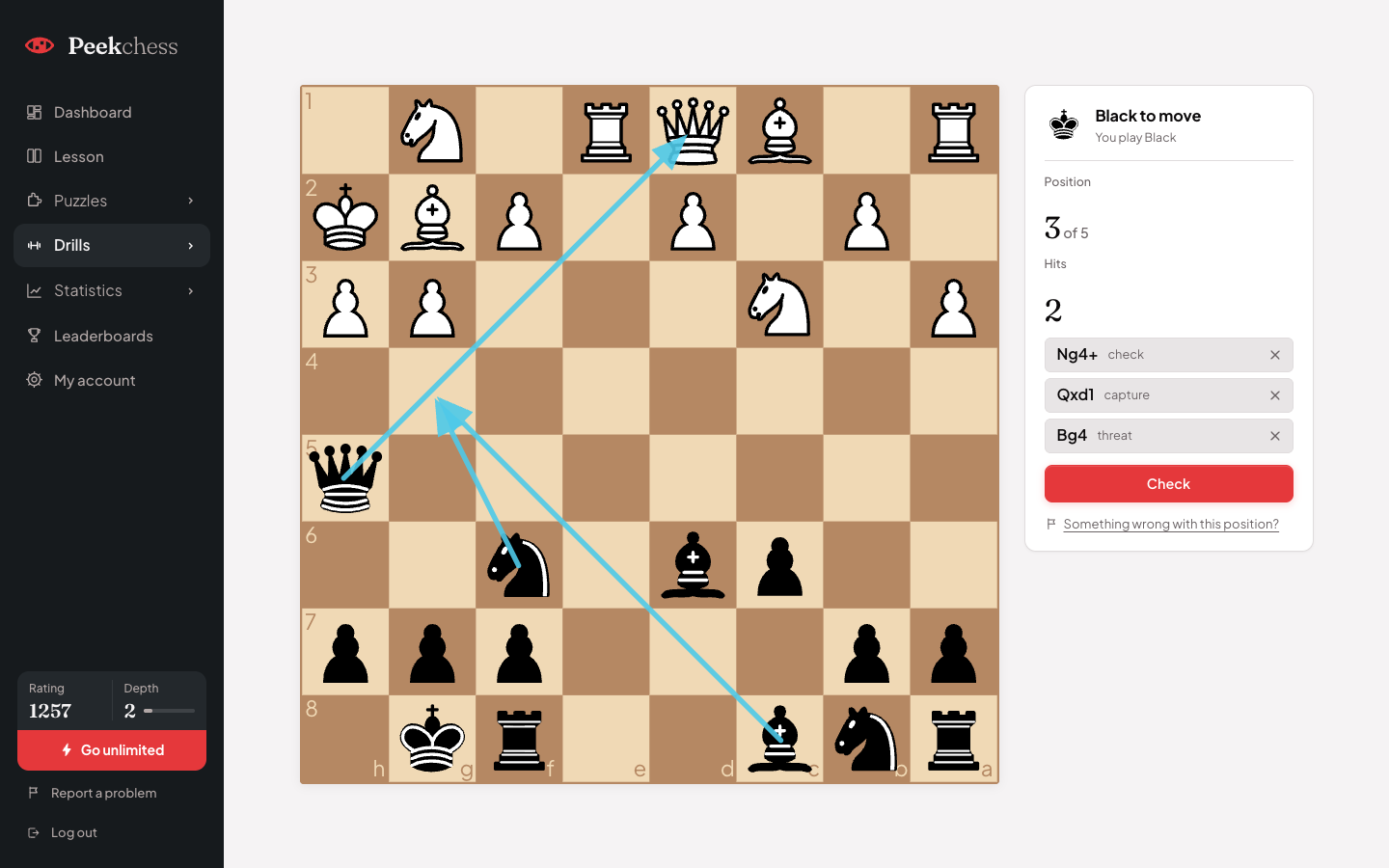
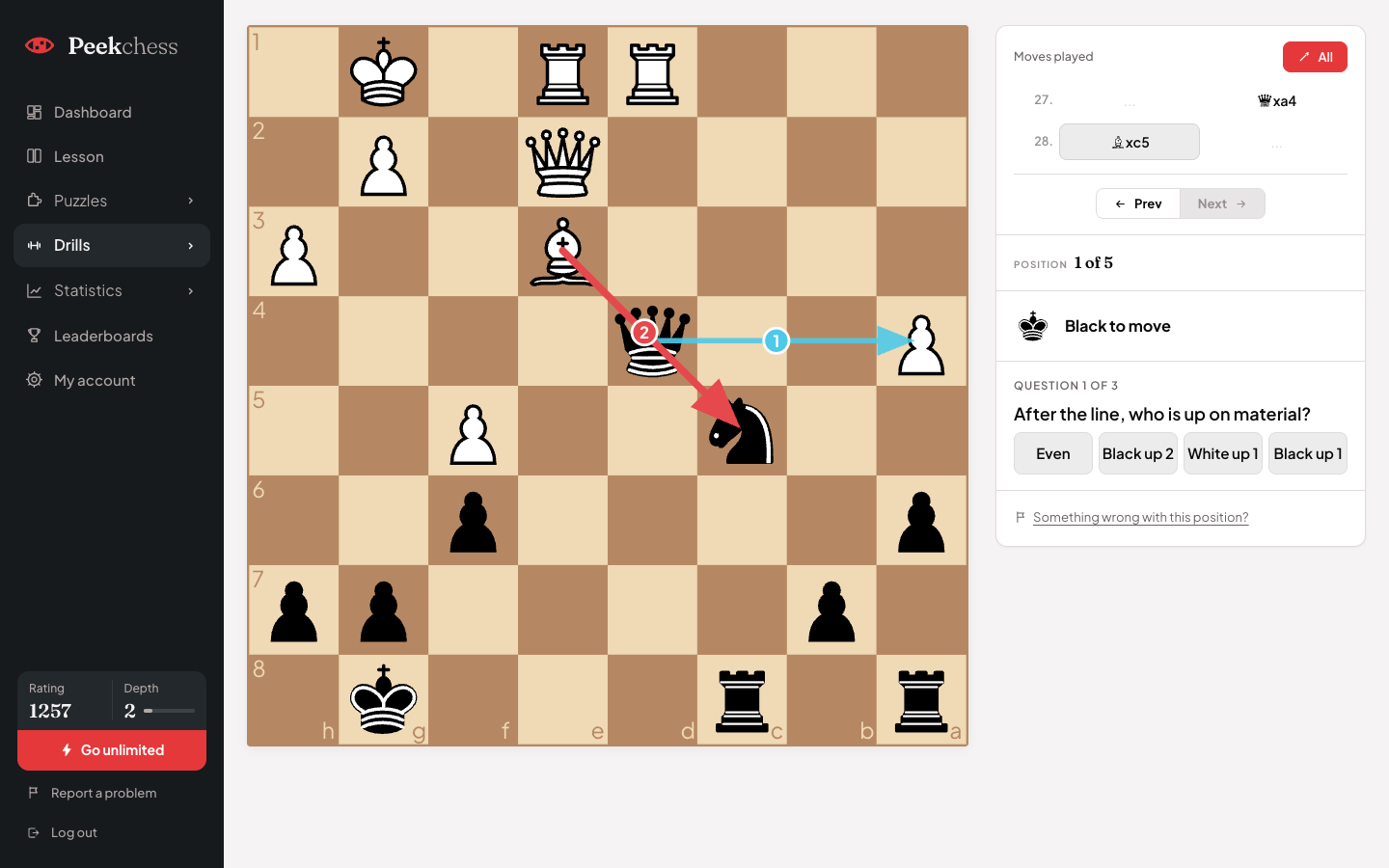
There's one thing to watch. On most puzzle sites, and on this page too, the board plays each reply for you, so in a long puzzle you only ever have to see one move ahead. You play a move, the position changes, you look again. That makes a hard puzzle a lot easier than the same position in a game, so calculate the whole line before your first move and let the board only check it. Peekchess, a chess puzzle app that trains calculation, works differently. The board stays still while you solve, and you play the whole line before anything moves.
If these were too much for now, start with the six in the chess tactics guide or the chess puzzles for beginners, and read how calculation works before you come back to them.
Read next. Chess tactics puzzles for calculation, Mate in 2 and Chess quiz.
What makes a chess puzzle hard?
Mostly what comes after the first move. Hard puzzles have long forcing lines, a quiet move in the middle, a defender with a real resource, or an ending you have to count. The first move itself is often a natural check or capture.
What is the hardest chess puzzle?
There's no single answer. Composed studies and problems, made by composers rather than taken from games, are usually the hardest, because the whole position is built around one hidden idea. Among puzzles from real games, the hardest tend to be long lines with a quiet move and a defence you have to see in advance, like the last few on this page.
What does a puzzle rating of 2500 mean?
It's the puzzle's rating, not a player's. It goes up when solvers get it wrong and down when they get it right, so it measures how hard the position is to solve. It isn't the same scale as a game rating, so you don't need to be rated 2500 to solve one.
How long should you spend on a hard chess puzzle?
As long as it takes to calculate the line to the end and check the final position. Speed isn't the point with hard puzzles. If you're still stuck after a long try, look at the first move only and calculate the rest yourself.
Should you solve hard puzzles or easy ones?
Both, for different reasons. Easy puzzles build pattern recognition, so short tactics jump out at you in your games. Hard puzzles train the depth and accuracy of your calculation. A good mix is mostly puzzles you can solve with some effort, plus a few hard ones worked through slowly.