Chess Puzzles Where You Enter the Whole Line

Chess puzzles where you must enter the entire variation, the full line, ask you for more than the first move. You give the whole solution, your moves and your opponent's replies, and the pieces don't move to help you along the way. I think that's what turns a puzzle into calculation training rather than just pattern spotting. There are three common ways of entering a line, and each one asks something slightly different of you.
This page is about the format itself. If you want the apps side by side with their prices, see the chess app that makes you calculate the whole line.
Chess puzzles where you must enter the entire variation, the full line, and calculate the moves, and what that asks of your calculation
It helps to separate two words here. A line is one sequence of moves from the start of the puzzle to the end, yours and your opponent's in order. A variation, in the full sense, also includes the side lines, which are the other replies your opponent could try and your answer to each of them. That's how annotated games are written.
Entering the whole line means you can't stop after the first move and let the site show you what happens next. You have to see the reply, then the position after it, then your next move, all from the one board in front of you. That's exactly what a game asks of you, because nothing moves until you play.
Three ways to enter a line in calculation puzzles
Commit the whole line, then see where your calculation broke
The first format has you write the whole line, both sides' moves, and commit it before you see anything. Calculation Training, at calculationtraining.com, works like this, with one position a day. You write the line by playing the moves on the board, but the board itself stays put, so every position after the first exists only in your head. If there's a defense you were worried about, it goes in brackets next to your answer. Once you commit, the analysis is fixed, and Stockfish shows you where your calculation broke.
Committing the whole line is strict, and I mean that in a good way. Every move has to be there before anything is checked, so a vague idea like "and then the knight comes in" won't get you anywhere. What you give up is speed, and you get no help at all until the line is in.
Play each move on a board that stays still, calculation without the pieces moving
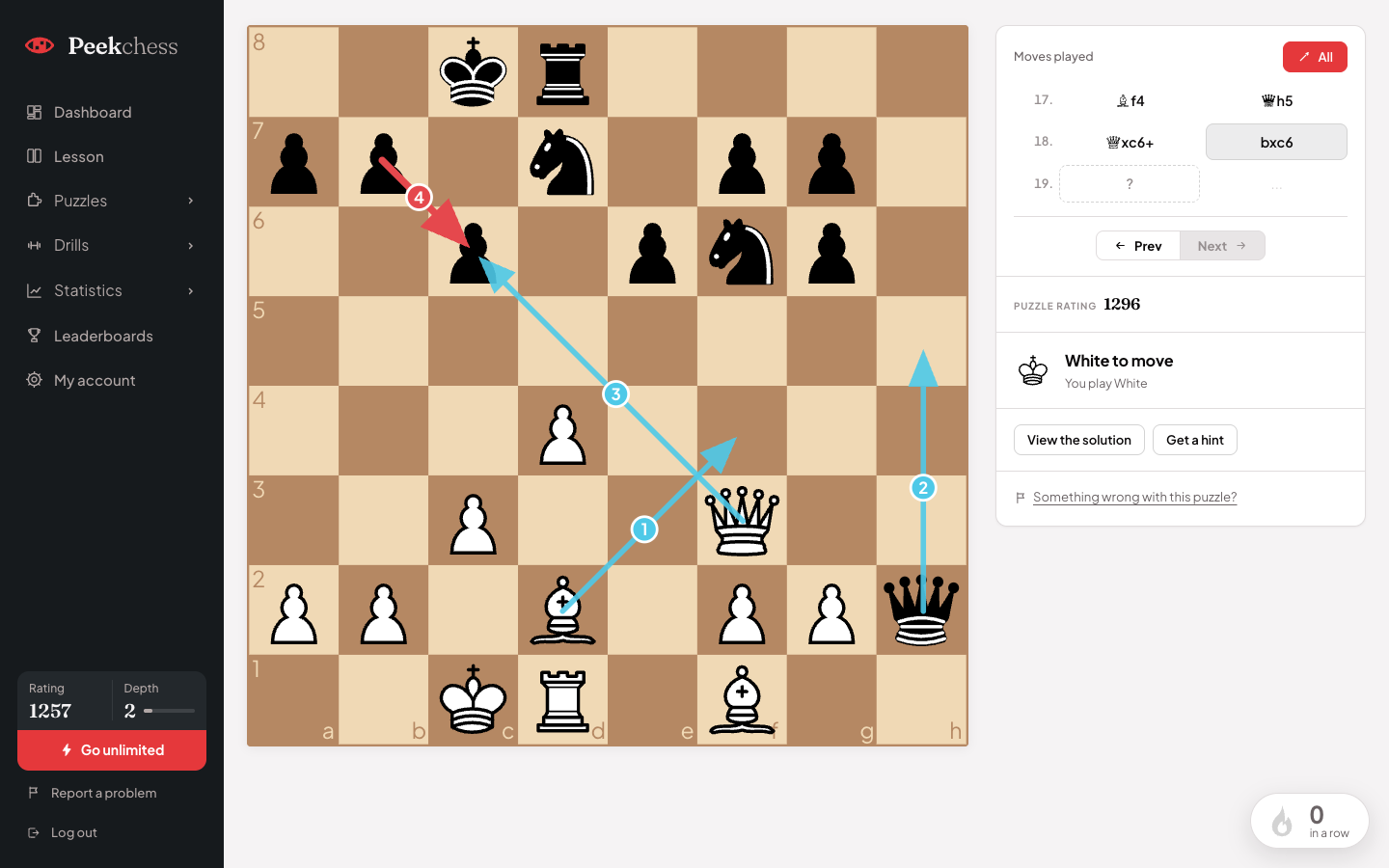
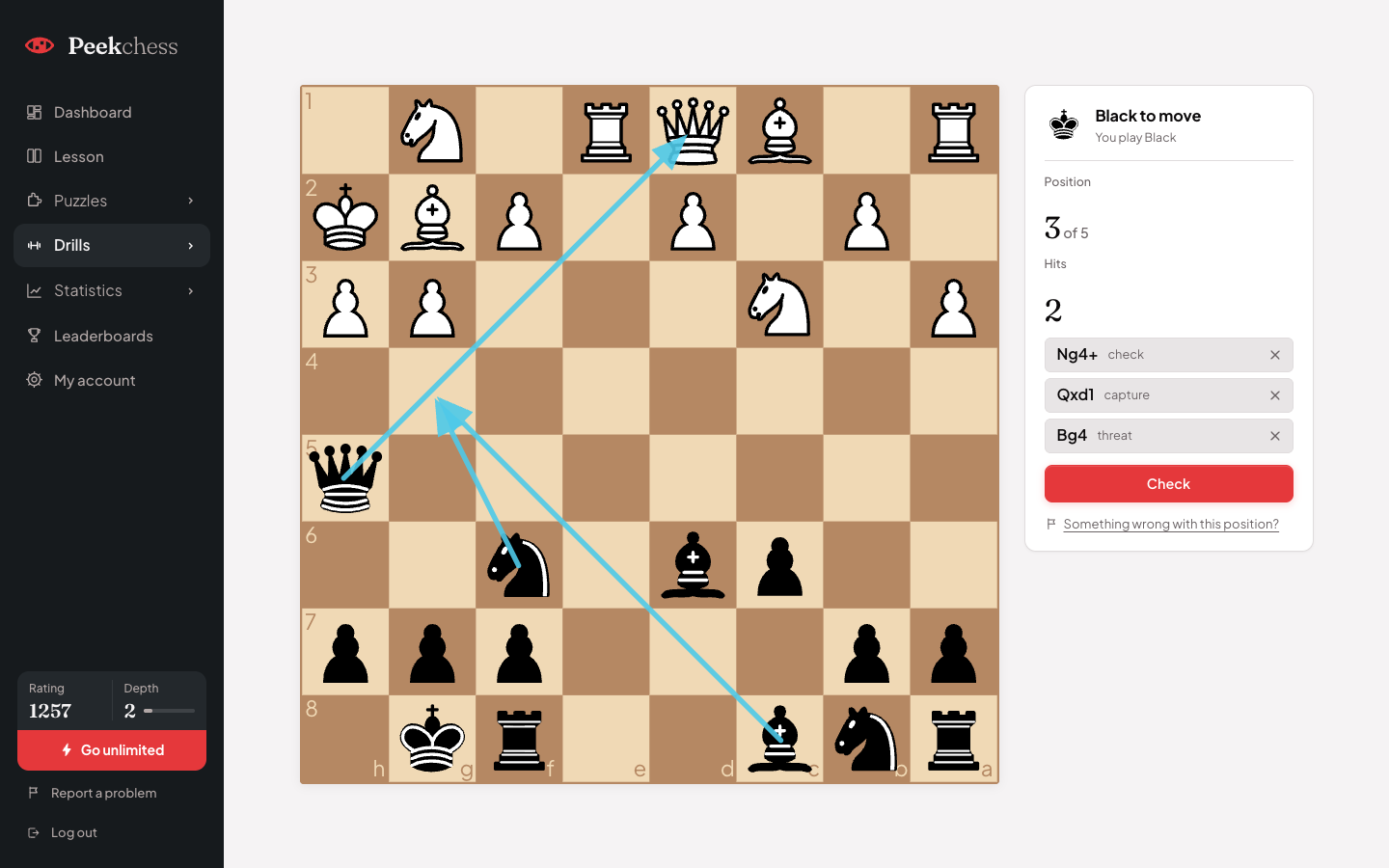
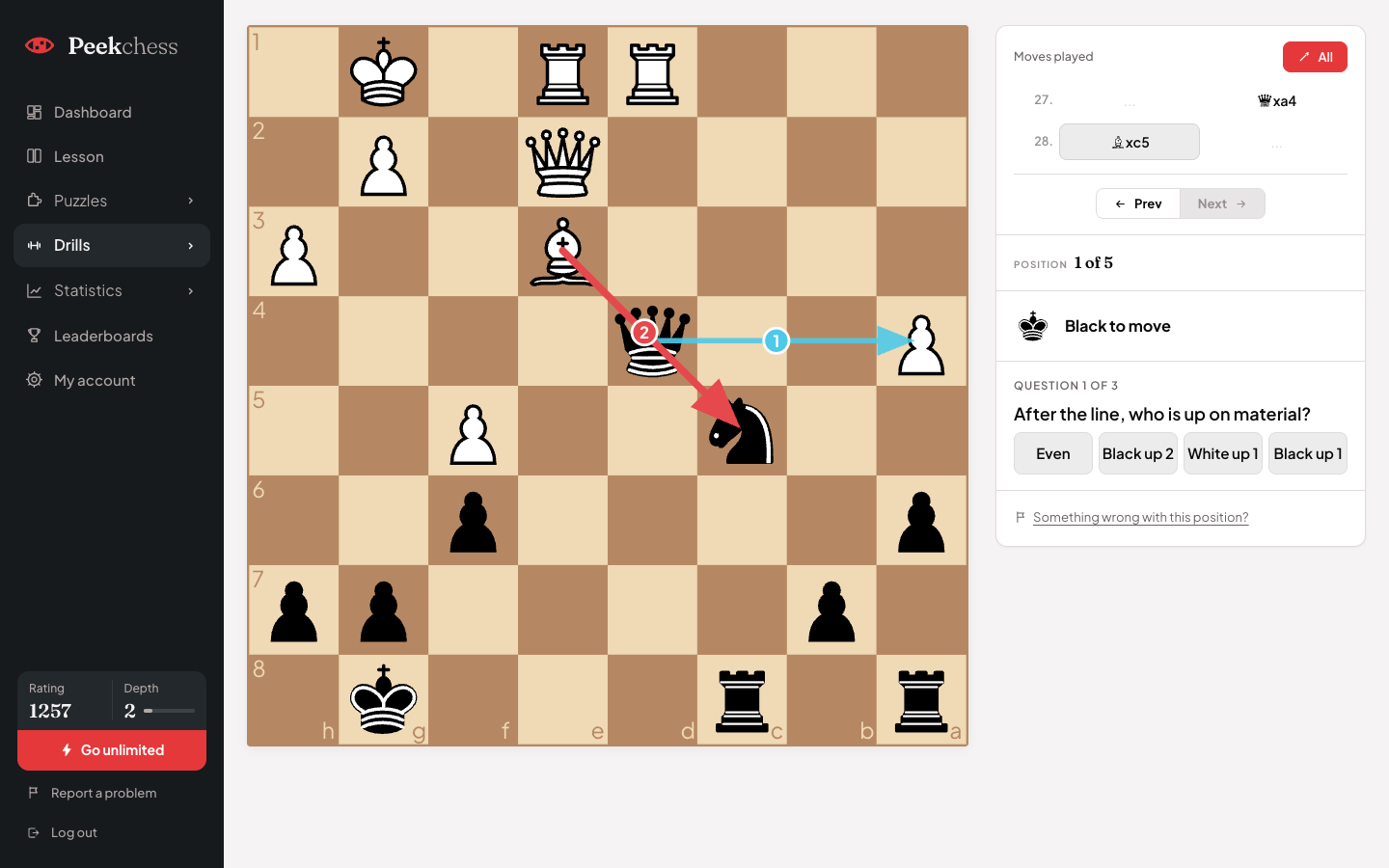
Peekchess does it differently. The pieces never move. Every move comes in as an arrow, the puzzle's first moves, yours and your opponent's replies, so the new position only exists in your head. You play every move of the line yourself, each one is checked as you play it, and one wrong move ends the puzzle. You don't type out the whole line and submit it at the end.
So you don't enter your opponent's replies, and you don't write out side lines. What you're really doing is carrying the position. A few moves in, the board you're looking at is a long way from the one in your head. Each reply is the one you'd most likely meet at your level, checked by Maia 3, so you're calculating against the defense you'll actually face. See how the method works for more.
Write it down from a book, the oldest calculation puzzle format
A puzzle book works this way by default, because a diagram can't move. Look at the diagram and write the full line on paper, both sides' moves, along with any side line you checked. Then turn to the answer and compare it move by move. If you missed a defense, mark it wrong, even if your first move was right.
It costs nothing beyond the book, and writing things down slows you down in a good way. The catch is that it depends on your honesty. Nobody stops you from peeking, and nobody checks a side line the book left out.
When the reply plays for you, calculation stops at one move
The mistake I see most often is simple. A player spots one move, decides it's great and plays it without calculating. And when they do calculate, they don't picture their opponent's best replies. They work out the line as if they could play several moves in a row while the other side just waits. The big puzzle platforms don't help with this, because they encourage you to calculate one move at a time. You play a move, the board answers for you, and only then do you look again. Do that every day and it turns into a bad habit in your games.
Most puzzle sites, ChessTempo among them, use a format that isn't on this list. You play a move, the site checks it, and the reply plays on the board. ChessTempo has 350k+ tactics and a rating for each theme, and its free plan is unlimited, so for volume it's great. The thing is, in this format you never enter the reply or hold the position after it, because the board draws each new position for you.
That's good training for pattern recognition. It just doesn't make you enter the whole line.
Chess calculation training puzzles, enter the full line of moves for both sides
Most calculation mistakes are about the other side of the board. You see your own move but not their answer, or you see their first answer but not the one after it. Entering both sides' moves forces you to name every reply before you go any further.
In Peekchess that is Full calculation mode. It takes one position through four steps (tactic, candidate moves, calculation, evaluation). You can calculate just the main line or the whole calculation tree, and every line is checked at the end.
Our count of 50,000 lost Lichess games shows where this hurts. We looked at the first move of the line that punished each losing mistake. In 96 of 100 it was a check, a capture or a threat. Under 1200, 56 of 100 were plain captures. At 2100 and up, 24 of 100 were threats. The stronger your opponents, the quieter the move you have to see coming. Naming their replies, and not only your own moves, is how you learn to see it. The full study has the numbers for each rating band.
Entering a line also shows you exactly where your calculation stops. If you can't write down the fourth move, you didn't see it. To me that tells you a lot more than a site saying your first move was right.
How to start entering the whole line in calculation puzzles
- 1Pick easier puzzles than usual. Entering the whole line is harder than finding the first move, so start a bit below your puzzle rating.
- 2Name both sides' moves. That means your move, their best reply, your next move, and so on to the end.
- 3Check one other reply. Before you commit, ask yourself what else they could play, and start with checks and captures.
- 4Count a wrong reply as a miss. Do this even when your first move was right.
- 5Make the lines longer slowly. Only add a move once the shorter lines feel easy.
To decide which moves to calculate and judge where a line ends, use the four steps in how to calculate in chess.
Questions about entering the whole line in calculation puzzles
Read next. Chess App That Makes You Calculate the Whole Line, Chess Puzzles Where the Pieces Don't Move and Hard chess puzzles to test your calculation.
What does enter the full line mean in chess puzzles?
It means you give the whole solution, your moves and your opponent's replies all the way to the end, not just the first move. Some apps check it after you submit, and others check each move while the board stays still.
Can I enter the moves of a chess puzzle without the pieces moving?
Yes. Calculation Training has you write the line by playing moves on the board, but the board stays put while you do, and you commit the whole line before it's checked. In Peekchess the board stays still too, and each move is checked as you play it.
Which chess puzzles make you enter both sides' moves?
Calculation Training has you write both sides' moves into one line by playing them on a board that doesn't move, with a defense you were worried about in brackets if you like. In Peekchess you play your own moves, and each move is drawn as an arrow on a board that stays still.
Do ChessTempo puzzles make you enter the whole line?
You play your own moves, but after each one the reply plays on the board, so you see every new position instead of calculating it. If you want it to train calculation, say the whole line before your first move.